The Challenge
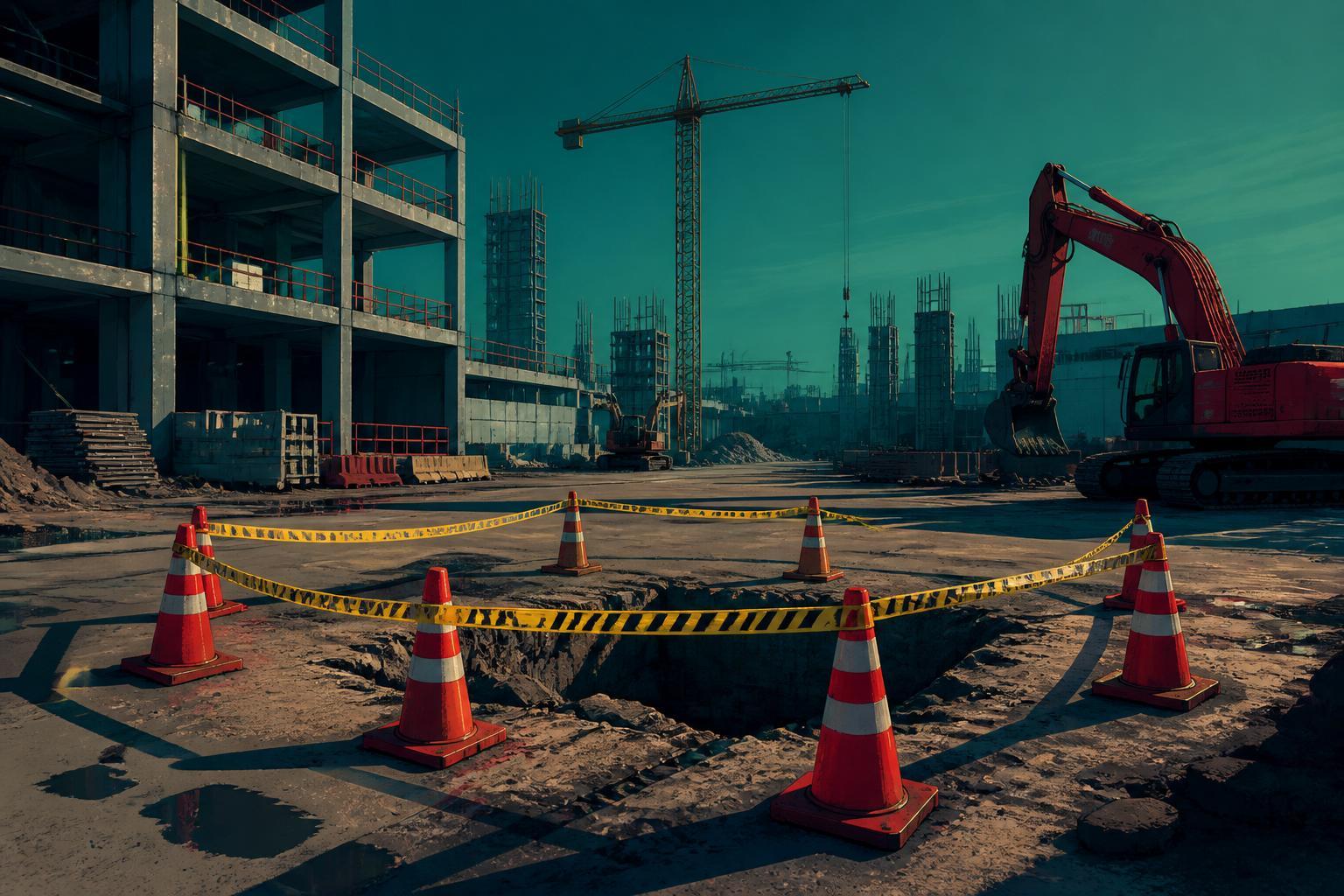
In October 2026, OSHA inspectors visited the Monroe Commons project site in New York after a report of struck-by and collapse hazards. They discovered a significant compliance failure: a nearly 75-foot-high excavation with an unstable embankment that wasn't properly sloped or shored.
The project involved multiple contractors on an 18-acre site preparing for a four-story, 408,000-square-foot mixed-use building. Workers faced daily risks of cave-ins, falling rock and soil, and chemical exposure. The inspection led to 28 citations across six employers, with $648,094 in proposed penalties.
Five citations were classified as willful, meaning the employers either knew about the hazard or showed indifference to the requirements. This indicates a serious lapse in safety compliance.
The Environment and Constraints
Large commercial construction projects are complex, involving multiple subcontractors with their own safety responsibilities. At Monroe Commons, the general contractor, Advanced Plan and Build LLC, and five subcontractors worked on excavation, waterproofing, paving, and structural tasks.
Excavations between 21 and 75 feet deep require specific OSHA measures under the Occupational Safety and Health Act. These include having a registered professional engineer design protective systems, conducting daily inspections by a competent person, and using protective measures like sloping, benching, shoring, or shielding.
General contractors are responsible for site-wide safety coordination, even when subcontractors employ the workers. Subcontractors must ensure excavation protection for their employees.
This project highlights a common issue: safety systems cost money and can slow progress. Proper shoring or sloping for a 75-foot excavation requires engineering, materials, and time. Economic pressures can lead to cutting corners.
The Approach Taken (and Where It Failed)
The employers, according to OSHA, proceeded without adequate protective systems. They failed to conduct daily inspections by a competent person and didn't engage a registered professional engineer for necessary depths. Workers were allowed near an unprotected excavation face where rock and soil could fall.
A competent person inspection involves a qualified individual examining the excavation daily and after any event that could increase hazards. This person checks soil classification, looks for instability, verifies protective systems, and can remove workers if conditions are unsafe.
The inspection that didn't happen would have flagged the 75-foot embankment without proper sloping or shoring. A competent person would have stopped work until engineers designed appropriate protection.
The willful citations against Advanced Plan and Build, Parkstone/Obstacle Systems, and The Paving Masters suggest these weren't oversights. OSHA determined these employers either knew the requirements and ignored them or showed such disregard that knowledge could be assumed.
Results and Metrics
The financial impact was immediate:
- Advanced Plan and Build LLC: $175,444
- Parkstone Inc./Obstacle Systems Inc.: $198,615
- The Paving Masters LLC: $188,684
- Century Max Industries Corp.: $46,340
- Prime Structure Inc.: $19,860
- DelValle Contractor: $19,151
These penalties reflect the severity classifications. Willful violations carry higher penalties than serious violations. The three employers with willful citations accounted for $562,743 of the total, or roughly 87% of the financial exposure.
Beyond OSHA penalties, each employer faces potential increased workers' compensation premiums, reputational damage, and the administrative burden of contesting citations or negotiating settlements.
The project likely experienced work stoppages while protective systems were installed, leading to schedule delays, potential contractual penalties, and impacts on other trades waiting to begin their work.
What They Should Have Done Differently
The fundamental failure was treating excavation safety as optional rather than a non-negotiable requirement.
Before starting, the general contractor should have required each subcontractor to submit excavation-specific safety plans. These plans should detail the competent person assigned to daily inspections, the protective systems to be used at various depths, and when engineering involvement is necessary.
At 20 feet of depth, a registered professional engineer is required. The project should have engaged that engineer early, incorporated the protective system design into the schedule, and included the cost in bids.
Daily competent person inspections should have been documented and shared across contractors. A simple form showing soil conditions, weather impacts, protective systems verified, and any corrective actions creates both accountability and a defense if OSHA shows up.
The general contractor needed stronger site coordination. When you see a 75-foot embankment without shoring, you don't need to be a safety expert to recognize something's wrong. Site supervisors should have had authority to stop any work that appeared unsafe and a clear escalation path to get engineering support.
Takeaways for Your Team
If you're designing safety training for construction teams, this case shows where your content needs to be specific and clear.
Train on the competent person standard. Explain what a competent person is, what they're looking for, and what happens when they find a problem. This includes soil type, water accumulation, cracks, and vibration.
Make depth thresholds clear. Your training should include decision trees: "If excavation depth exceeds 5 feet, you need protective systems. If it exceeds 20 feet, you need a registered PE. If soil conditions are unstable at any depth, you need engineering review."
Address the cost objection directly. Acknowledge that safety systems can slow things down, but explain that OSHA penalties, project shutdowns, and injury costs are far greater. Use this case's $648,094 figure as a concrete example.
Clarify multi-employer responsibilities. Subcontractor employees need to know they can refuse unsafe work even if another contractor created the hazard. General contractor supervisors need to understand their duty to coordinate site-wide safety, not just their own crews' activities.
Build documentation habits. The competent person inspection should produce a written record every day. That record protects the worker doing the inspection, creates evidence of compliance, and gives the next shift visibility into changing conditions.
The Monroe Commons citations demonstrate that excavation safety isn't about good intentions or general awareness. It's about specific, measurable actions: engineering at certain depths, inspections by qualified people, protective systems that match soil conditions. Your training needs to be equally specific about who does what, when, and what happens if they don't.